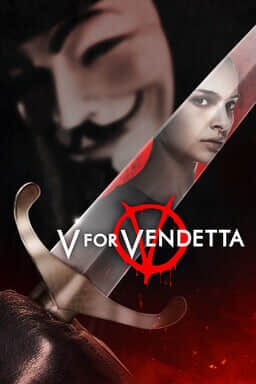
V FOR VENDETTA

Has directing a feature film been a long gestating consideration for you?

James: It was always in the back of my mind from university that it would be cool to direct something. I went to film school and I had a mentor, a really smart guy who was an assistant director, but had also directed his own film. He was taking a sabbatical in my last year at university and I got pretty close with him, and when he went off to do a film he asked, "Hey, do you want to become a third AD?" on the film he was doing. I said, "Oh yeah, sure," so I went off with him and did the film and got into assistant directing. I was third AD for a while, then a second AD, and then obviously a first AD. And, in that way you do, you get stuck in doing something. I didn't get stuck in something bad, I worked on lots of really good films, which was a bonus. That's what's great in some ways about Larry and Andy, they're like, "Hey, we think you can do a film, how do you feel about doing a film with us?" So it was a great kind of natural progression in the end.

I think assistant directing falls in two camps: you can be weighted towards the production side, or you can be weighted towards the directorial side. Some of the better ADs are weighted to the directorial side, after all, you're called the assistant director not the assistant producer, but you obviously have to have a marriage of those two. You have to think about what the production needs and what the director needs, and I always thought a better way to do it was to be a bit more creative, and I guess that's how it sort of turned out with the Wachowski Brothers.

V was written many years ago; what was your familiarity with it before being brought on to direct?

James: I knew that they'd written some films when they had their deal with Warner Bros.: I think it was Plastic Man and V. We were doing post-production on The Matrix sequels and they said, "Have you read this?" I hadn't actually read V, so then I read it and came back and said, "Hey, that's cool. I'm surprised, I never read that before!" Then they said, "There's a script for it too, why don't you read that and see what you think about it?" So I read that and we started talking about the film from there. The thing is that when Alan Moore wrote it, it was prescient and timely to the climate that he was writing it in, and V still holds up so well but also for other reasons. The themes and the ideas are still so relevant, we thought it would be good in the post 9/11 environment to drag it out of the drawer. This is a good film to make in this political climate.

Were there moments along the way where you wondered if the film would go ahead?

James: Yeah there were. The sort of thing that you have just before a film goes… can it go? Can we get the finance in? Is the studio into it? We searched all over Europe for studios and ended up in Berlin [Studio Babelsberg] and we went and just kind of held on. I think that was where it was lucky to have people like Grant [Hill] and Larry and Andy [Wachowski], as we'd all worked together before so it was kind of like, we know what we're doing so let's go about doing it.

What was the fist thing that you did when you knew the film had been green lit?

James: Well, that's a funny thing on films. You're never really kind of green lit anymore. Maybe some films in the traditional sense of the word get green lit, but now it's a matter of you can go for another week, you can go for two weeks, now you have a production designer on, now you have someone scouting locations in Europe. It's that sort of piecemeal kind of thing, but I guess this film always had a momentum. There was one time there where we didn't know if the tax deal was going to work out alright and we might have stalled there for a minute, but even that sort of happened over a weekend and went away. It's been pretty remarkable.

Larry and Andy have made some successful films, so to have them as writers and producers on the film and have the same sort of Matrix team gives the studio a comfort level that they wouldn't normally have. In some ways it was brave of Joel [Silver] and the studio because the film is politically charged, there's no doubt about it. It says things, and I think the great thing about it is it puts the questions out there, and I think the studio was brave enough to say it's a good climate to ask those questions.

CASTING

With that political climate element, did you find any of the casting difficult? Was anyone you approached nervous or afraid of the material?

James: So far I haven't come up against "No, I'm afraid of it"… but the film is very ambiguous. The main character on one hand has this murderous vendetta, and on the other hand has this notion of how he can change society by bringing the downfall of a government. So his personal politics and the political ideology is very ambiguous - I wouldn't say confused, I would say ambiguous. Getting back to the casting question… it's interesting, I think, in the film community, which is what I was dealing with, they're people who like to ask questions and they don't like to have the easy answers. Especially Natalie [Portman, Evey] and Hugo [Weaving, V] and Steven [Rea, Finch], they're sort of fearless in that regard. They love that the script asks questions and they love that there are no easy answers, and that the audience should take their own solutions away from the film.

At what point was the casting of the main characters finalized?

James: In some ways the casting came first because you have a film with a guy in a mask, and the other main character in the film is the young girl. You kind of need to get that part of the casting [Evey] locked off because your male lead is going to be someone behind a mask. We saw some actors, but I always had Natalie in mind, and as soon as Natalie was attached that made the studio really pleased. Then it moved forward from there.

The way we did it was: we got the script into a shape that we thought was good, then it was the casting, once we got that away, we started looking for somewhere to make it. We knew that part of it would be set in London because the story is very London-centric, so we started to look at what we could do in Europe and then once that fell into place, we went scouting different studios in Europe. I started doing storyboards, Owen [Paterson, Production Designer] came on board and he started doing initial sketches, and it kept going, one foot after the other.

What did you storyboard and why? Were the storyboards influenced by the graphic novel?

James: The things that you want to storyboard are the things you know are going to be difficult, the big set pieces: like the Parliament set piece or the Victoria Station set piece, or even down to the television station, which I knew would be a short schedule. So you know you need storyboards for certain sequences, and of those sequences more often than not the ones you do the earliest are the visual effects sequences. I asked Steve Skroce to start on storyboards, and I think the first sequence he drew was the Parliament sequence, then the second was the Victoria Station sequence.

Getting back to the graphic novel… it's drawn in a really cinematic style, but I didn't want the film to be a graphic novel put onto film because in some way for me the film is a political thriller. I think the ideas and what the people are talking about in the graphic novel are somehow more important to me. The graphic novel was a leaping off point, and every now and then I did some homages to the comic, so you'll go, "Ah! I've seen that somewhere before!"

THE MASK

V is an unusual character in that you don't see his face or expression at all; did you envision how someone would be able to portray this character?

James: The Guy Fawkes image and the one in the graphic novel is great. Because the mask was going to be so strong it was going to be difficult, but with the correct kind of lighting and the correct kind of atmosphere and the correct kind of actor you would really get the sense that there is that very complex, emotional person behind the mask. I think the mask itself, even though it's a caricature of half harlequin mask and half Guy Fawkes with the hair and the hat, I really thought I'd be able to get something across with it. I also envisaged when we were designing and making the mask, a lot of it would be played by the interreaction that V has with the different characters. I think a lot of that will be reflected by whomever he's talking to. Subliminally they will feed into what you see on the mask, by judicious cutting.

When I first saw the mask, it struck me as a beautiful piece of craftsmanship. Then I started seeing it in play and loved how it appeared to change under different lighting. How difficult was locking down the design of the mask?

James: The Art Dept. did an amazing job. It was molded from clay by a real craftsman, a great sculptor, Bern. Then it was an evolving process to see how it'd work. As I was going along, I could see it was nearly there but not quite, and so I went back to the graphic novel and wondered why does it work so well? After a while it dawned on me that David Lloyd cheated a little bit: depending on what the scene was, he'd make him a little more sinister, or he'd make him a little more benevolent, or he'd make him a little bit stronger by subliminally altering the lines on the mask. Obviously we couldn't do that. So we went for the iconic kind of mask and then we started doing some tests with it.

In the first scene it became apparent that it doesn't absorb light like a human face does, it bounces the light straight back at you. So that became difficult because it's kind of hard to light. The mask looks good when it's three quarter back lit and it has a bit of light and shade on it and it's not really white… like sometimes you want it to be ghost-like and white but other times you want to do what they've done in the graphic novel, which is make it more sinister, make it a little bit more caring or a little bit more emotional. It was a process of discovery while we were filming with it! What I did find out in the test period was that I might be able to alter it later, in the digital intermediary process. I might be able to shade it a bit, because otherwise, you're in a room, you can't light it how you want, and the mask has to go from pools of light to half pools of light to complete darkness.

WHITEHALL FILMING

How far in advance did you know you had received permission to film in Whitehall?

James: The first survey was in October of 2004. The finale happened around Whitehall and Parliament. When we came here we just went right out and asked, "Hey, what do you think?" and the location manager [Nick Daubeny] said, "I think you're out of your mind! I think you're dreaming, actually." He said it hadn't been done, but he'd go ahead and ask. I had a meeting with him and a representative from the British Film Council and she was very positive, much to the surprise of Nick, the location manager. After the initial foray she came back and said, "They said yes, so I guess we'll go to the next level."

So it just kept going, one step after the other, and at every point along the way, we expected someone to say no, but no one said no, so we ended up with everyone saying yes and then we ended up closing down Whitehall and we ended up in front of Westminster. That's not to trivialize how it happened, but I think it was a result of good planning, good luck and being here right at the right time. I think everybody was up for it. London has always been a difficult town to film in because it's broken up into so many boroughs and all those boroughs have their own film council, but this time everyone coalesced and came together and said, "Yes! If you guys want to do it, we recognize it's a work of fiction. We think it'd be great to do, so go ahead and do it."

Did you have to send the script?

James: Yes. Part of what Warner Bros. has you do, if you go to a location, is send the parts of the script that pertain to the location, because it becomes a legal thing, obviously. I think it's kind of fantastic, because what you'd expect them to say is, "Oh, OK, hang on, this is cutting a bit close to the bone," but I think everyone recognized that, it is set in the future, it is a work of fiction. I think they're smart, intelligent people who think people should make their own conclusions.

V'S COSTUME

For V's costume, how did you put across what you wanted to Sammy Sheldon, the costume designer?

James: There are a couple of leaping off points, one is the graphic novel. The costume Alan Moore and David Lloyd put him in, is the traditional costume from the period. Ideas also came from a very nice book about the Gunpowder Plot that has lithographic drawings and wood cut prints. I thought what would be good is to not make it as traditional or period correct as Alan Moore did. I said to Sammy that I wanted it to have the tradition, but I wanted him to be a gunslinger as well, which I believe is the first thing I said to her.

The cloak we made a little bit shorter, and for the hat I got Sammy to design something that almost looked period correct but an element of cowboy-ness to it. And then the knives I had made like guns that sat on his hips. Then we got into a discussion about making the lines of the cloak and the pants and the boots cleaner, more simple, more modern. It was like he'd taken the tradition of the past and kind of updated it himself and made it functional, so it kind of looked cool.

Ultimately it had a mix of periods: it was traditional, and then it had a bit of the cowboy gunslinger element, and then it had maybe something owing a bit to the future and then, because it was going to be all black, to make it as textural as possible. The cape is a dark charcoal and the tunic, the doubler, has little crosses on it. The boots are this funny cross between soft leather boots and biker boots.

I found some reference of period knives that I really liked and asked Simon Atherton, the armorer, to put a bit from this knife and a bit from that knife, and he went and furnished those knives, which I thought were pretty cool. Then it was a matter of just working a way he could draw them and put them back in. Also, I wanted the knives to look like metal teeth that glistened when he opened his cape, rather than have them sheathed in anything. The knives were crafted specifically because they were a hybrid of a couple of things together. Simon did an amazing job on the knives. I was pretty pedantic about them, but they turned out fantastic.

What was the most difficult aspect of the knives?

James: The blade and the length I was happy with. The handle was hard to get right because it's tightly bound leather, but then it has an inlay of like gold chain around it. Without the chain the leather was too dark and I wanted something to catch the light.

The knives are used in the Victoria Station sequence that was stunt coordinated by Chad Stahelski; what did you talk with Chad about in the way that V would fight?

James: There were a couple of things. There are three action pieces where V uses these knives. The first one is in Fingerman Alley when he first meets Evey; from that one I just wanted to get his speed and his agility, but also that he was such a master with the knives that he could choose to use them exactly in the way he wanted. So in the Fingerman Alley he used them to fend off people, but not to kill people.

The second piece was in the TV station, when he's trying to escape. You get the idea that he almost has this super human speed and ferocity that can get him out of the TV station. The third one is Victoria Station where he is completely superheroic, even though the film is a play on the superhero convention. Every time that he uses the knives you want it to be a little more cathartic. You want to feel it because a lot of the film is so interior and so dialogue heavy, when you have the action pieces you want it to look cool and move fast and for V to be able to use the knives in whatever way he wants.

In talking with Chad we discussed how he should be able to move, that he should be able to throw, that he should be able to parry, that he should be able to be the complete master of that knife universe. We started there and Chad came up with some great ideas and then we brought Dave [David Leitch, V Stunt Double/Assistant Stunt Coordinator] in and together we came up with the fights for Fingerman Alley, the TV station and Victoria Station.

On set V's voice is a little muffled behind the mask; was there ever a thought to record it live or was ADR always the likely option?

James: I wanted to mike it, but I knew by miking it, it would never be in the final film. We did try to mike it: I got them to make a mask that was more hollowed out around the mouth, but all it does is once you put a mike in there, it just bounces back against the outside of the mouthpiece. So then we miked him along the hairline, up above the ear as well, so he's miked. What you get by miking him live, which is great, you get the performance. So when you get into ADR we're not starting afresh; I can go to take 4 or take 7 or take 9 and go, "This is what I loved about that, that's what I loved about that, that's what I loved about that. Hey, Hugo, can you string that all together for us?" I think it'll make ADR fantastic. I was quite particular about getting what I wanted out of the takes and even though it was muffled to my ear, vocally, I could hear where he was at in his performance. So I thought that'd be a good way to do it and it's turned out to be pretty good because now I'll play Hugo the tape and he'll go, "OK, I know where I am emotionally."

FILMING

How are you approaching the death of the little girl dressed in a V costume?

James: She'll have the same cape, like she's made up a little cape for herself, and she'll have the mask on. The tricky part about that is I want it to be quite violent and visceral because it's at a point in the story that you know is the culmination of events. It is at the point that the government, in the name of keeping things in control, thinks it's OK to kill a little girl, and then the government is completely out of control and has lost control. So I think whereas it will be a shocking moment, I think it's also a good cinematic moment, and I don't say that lightly. The death of someone in a film is always difficult, but in context I think it works well. The little girl works well. Because I want to make it quite visceral there, trying to work out how they could put her in a harness and pull her back and whether to get a stunt double and all that, I think in the end it'll be fine. She'll get shot and I'll do it in cuts. But yeah, it's not the easiest thing in the world to shoot.

How closely are you going to be working with miniatures?

James: They will be going concurrently while I'm editing. I probably won't go out there while they're shooting it because it's set pieces and the cameras are going to be set and that's all been decided with Dan [Glass, VFX Supervisor]. Also, we get to do each shot twice. They'll shoot it, I'll get to see it, and if they need to change something, then we can change some things and do it again. Yeah, I'm looking forward to that, there'll be some good explosions there!

With five days left of principal photography, how is everything generally?

James: I think it's good. I was saying to Sarah [James's wife] last night it's such a great experience to make a film, but in some ways it's a form of torture for yourself, too, there is a constant level of anxiety. Are you ever completely happy with what you get? So there's always that constant, "If only I could do that, if only I could do that," and at the end of the day, you have to make peace with that. The last three nights [filming on Whitehall] have been great, but they've also been difficult. You have a certain amount of time to get things, and you get it and you move on and that's the great part of filmmaking. Every day you march forward and every day you learn something that you can use the next day and generally I feel really good about it. There's a good film in there.

When you're in the middle of filming you're like, "Oh my God! I'm so tired! Another 12 hour day! I can't believe it." But then you get towards the end and you see the end and you go, "Oh, I'm just really hitting my stride now, this would be great if this could go on forever, or another 12 weeks." Today is a good example, in some ways I feel energized about last night [shooting in front of Parliament and Big Ben]. I'm looking forward to cutting the film and seeing what's in there… hoping it's all in there.

Thanks James.


Interview by REDPILL
June 2005